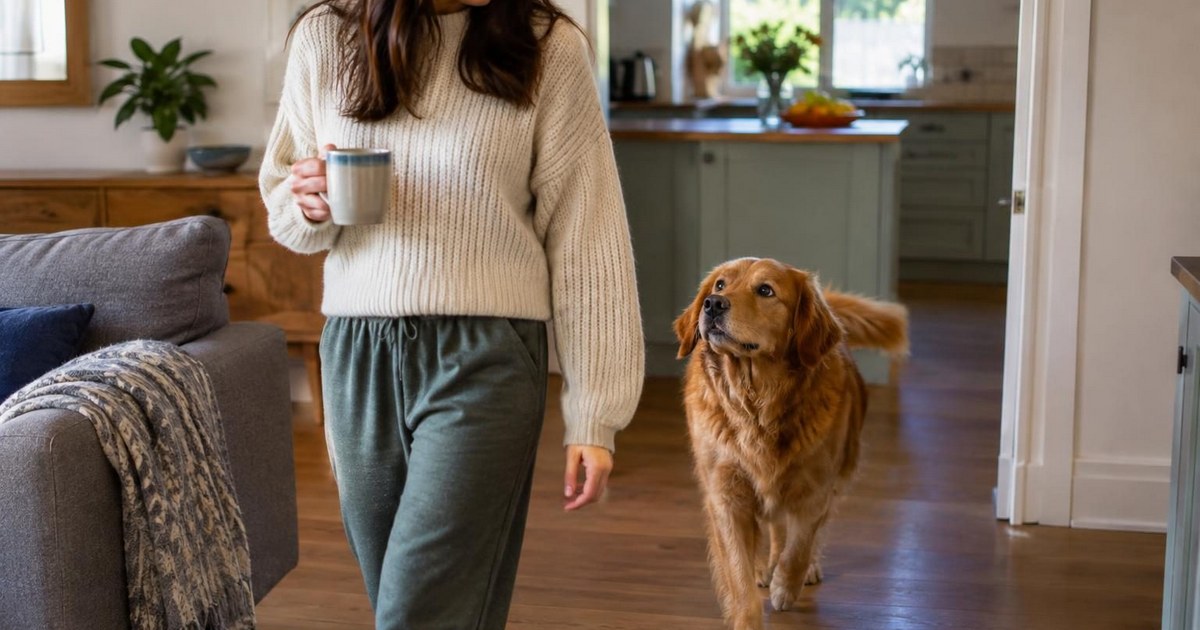
You stand up to make tea and your dog gets up too. You move from the kitchen to the sofa, and there they are, settling one step behind you. For many dogs, this is an ordinary expression of attachment and curiosity. For others, especially when the behaviour appears suddenly, a once-independent dog turning into a constant shadow can be a useful clue that something in their world has changed.
The key is not to count how many rooms your dog follows you into. It is to notice whether this is their familiar personality, or a meaningful departure from it.
WHAT NORMAL FOLLOWING LOOKS LIKE
Dogs are social animals, and home is full of reasons to keep track of the humans they live with. You may be heading towards a food cupboard, picking up the lead, opening the back door or simply moving to the warmest patch of sun in the next room. A dog who follows can be keeping company, hoping for activity or choosing the place where they feel most comfortable.
Some dogs are also naturally more people-oriented than others. A young dog still learning household routines may trail their owner closely. A rescue dog settling into a new home may take comfort from knowing where their person is. Older dogs may prefer company and predictable routines. If your dog has always quietly accompanied you, then curls up and relaxes when you stop, there is usually no mystery to solve.
It can even be a small sign of trust. Your dog has chosen to be near you without demanding anything, and many owners find that companionship one of the loveliest parts of sharing a home with a dog.
WHEN “SUDDENLY” IS THE IMPORTANT WORD
A change matters more than the behaviour itself. Think about the dog who once slept upstairs while the household watched television, but now follows one person from room to room and becomes unsettled when they disappear behind a door. Or the dog who has begun hovering near their owner at night, waking frequently or asking to go outside.
That does not automatically mean a serious problem. Dogs often become clingier after a move, a holiday, a change in work hours, visitors, building work next door or the arrival or loss of another pet. Even a family member wearing a hat, using crutches or smelling different after hospital can briefly alter a dog’s sense of what is familiar.
Look at the whole picture. Has your dog’s following arrived alongside pacing, whining, trembling, hiding, panting when they are not warm, reduced appetite, disturbed sleep, accidents indoors or reluctance to be left alone? Is it focused on one person? Did it begin around a clear change in routine? Those details are more useful than the label “clingy.”
A DOG MAY BE ASKING FOR REASSURANCE
Dogs often seek proximity when they feel unsure. Thunder, fireworks, unfamiliar guests, a noisy appliance or a stressful experience outdoors can leave a dog wanting a reliable base. In these moments, being near you is a sensible coping strategy from your dog’s point of view.
Try not to punish or repeatedly push them away for following. That can add conflict to an already uncertain situation. Instead, make the environment easier to read. Keep meals, walks and resting times fairly predictable. Offer a quiet bed in a room your dog already likes. Close curtains during noisy evenings if outside activity is bothering them, and give them a calm place to retreat rather than insisting they stay in the centre of household life.
Calm company can help, but it is also useful to preserve your dog’s ability to settle without you. A long-lasting chew, a food puzzle or a scatter of part of their usual food on a safe snuffle mat can create a pleasant independent activity. Start while you are still nearby. The goal is not to trick a worried dog into coping alone, but to rebuild the idea that resting at a small distance is safe and rewarding.
THE DIFFERENCE BETWEEN FOLLOWING AND STRUGGLING TO BE ALONE
A dog who likes to accompany you can still be perfectly comfortable when you leave the room or go out. A dog with separation-related distress may show a different pattern: escalating anxiety as departure signals begin, vocalising after you leave, destructive behaviour around exits, toileting indoors despite being reliably house-trained, or frantic greetings that feel less like excitement and more like relief.
You cannot always judge this from the doorway. A simple camera or an old phone set up safely to observe a short absence can show what happens after you have gone. Some dogs settle within a few minutes. Others remain restless. Avoid making a dog “prove” they can cope by leaving them for longer than usual while you test the problem.
If you see signs of genuine distress, speak to your vet. Physical discomfort and some medical issues can affect behaviour, and a vet can help decide whether a referral to a suitably qualified behaviour professional would be useful. Early support is kinder than allowing fear to become part of the daily routine.
PAIN, AGEING AND CHANGES YOU SHOULD NOT IGNORE
Following can occasionally be linked to discomfort or age-related changes, not because dogs are being dramatic, but because staying close may feel safer when they are less comfortable or less sure of their surroundings.
Pay attention if the shadowing comes with stiffness, trouble getting comfortable, reluctance to use stairs or jump into the car, reduced interest in walks, yelping, changes in thirst, changes in appetite, confusion, or new night-time restlessness. A dog who seems unable to settle, repeatedly asks to go out, or suddenly needs much more reassurance deserves a conversation with a vet, particularly if the change is persistent or worsening.
This is not about assuming the worst every time your dog chooses your side of the sofa. It is about treating a new behaviour as information. Dogs cannot tell us, in words, that something feels different. Their routines often tell us first.
HOW TO RESPOND WITHOUT MAKING THE HABIT BIGGER
If your dog is healthy, relaxed and simply very devoted, there is no need to turn ordinary companionship into a training project. You can enjoy it. But if you would like a little more space, teach it gently rather than shutting a door and hoping they adapt.
Choose a bed or mat and make it worthwhile. Put it in a spot where your dog can still see you at first. Reward them for stepping onto it, lying down and remaining there while you move around briefly. Return before they feel the need to get up and follow. Build duration slowly, then practise in different rooms.
It also helps to make departures and returns boring. No lengthy apologies before popping upstairs, and no huge reunion every time you come back from taking the bins out. Quiet, matter-of-fact movement teaches a dog that short separations are a normal part of the day.
Give your dog satisfying activities that do not depend on following you: a sniffy walk where they can explore at their own pace, short reward-based training sessions, safe chewing time and a comfortable place to rest. A dog with a settled routine and appropriate outlets is often better able to relax when nothing much is happening.
WHAT YOUR DOG’S SHADOWING CAN TELL YOU
A dog at your heels is not always making a grand emotional statement. They may want to know whether the fridge is opening, dislike the vacuum cleaner, enjoy your company or have noticed that the household rhythm has shifted. Context gives the behaviour its meaning.
The most useful habit for owners is to notice change without panic. Ask when it started, what else changed at the same time, whether your dog can still settle independently and whether any physical or behavioural signs have appeared alongside it. That short check-in can separate a sweet everyday habit from a dog who needs reassurance, a routine adjustment or veterinary help.
And if your dog has always been your quiet, loyal shadow? They may simply be doing what they do best: keeping their favourite person in view.