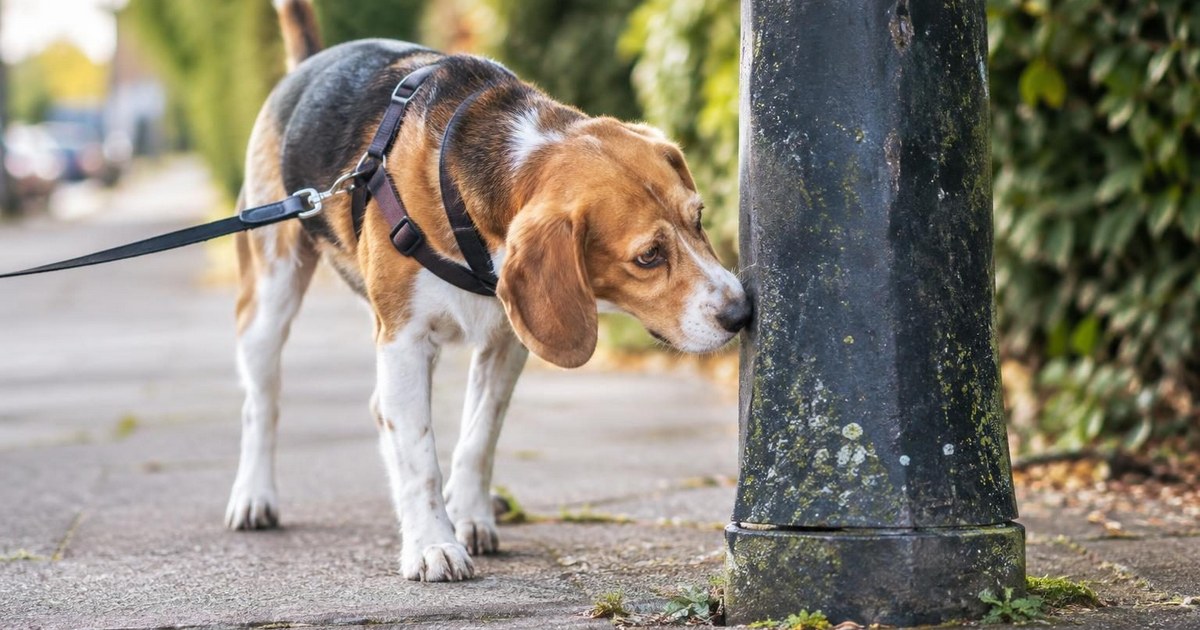
The next time your dog appears to be reading every blade of grass on the pavement, try not to assume they are simply being difficult. For dogs, a patch of urine can be a remarkably information-rich calling card. It may help them learn who has been nearby, influence whether they mark the same spot and shape how they approach the next dog they meet.
That does not mean every prolonged sniff has one neat translation. Context matters, and dogs are individuals. But these five small moments can make the ordinary lamp-post pause far more interesting to watch.
1. They turn a lamppost into a chemical introduction
A dog’s nose is built to notice details that are unavailable to us. Chemical signals, including pheromones, are part of how animals communicate information without being in the same place at the same time. VCA explains that pheromones are chemical messengers that can affect another animal’s behaviour or physiology.
So when your dog lowers their nose to a hedge, takes several short sniffs, then moves a few inches to inspect another patch, they may be sampling more than a general smell. Urine marking is one form of canine communication, and the location matters too. A message on the corner of a familiar walking route may be especially likely to attract attention because other dogs also pass there.
Watch the intensity rather than the length of the stop alone. A casual sweep of the grass often looks different from the focused, nose-planted investigation that makes you wonder whether your dog has forgotten you are holding the lead. That concentration is a good reminder that a walk is not just exercise. It is one of the few chances your dog has to gather news from their neighbourhood.
2. They lick the air after a particularly good sniff
It can look comical: your dog investigates a scent, lifts their head and makes a tiny tongue flick or appears to taste the air. In many cases, this is connected to the way dogs process scent. Dogs have a vomeronasal organ, also called Jacobson’s organ, which is involved in detecting certain chemical cues. The American Kennel Club notes that air-licking can occur while a dog is taking in an interesting smell.
Think of it less as a strange habit and more as a change of sensory gear. Your dog may be pausing to process a particularly information-heavy smell rather than deciding that the pavement is delicious.
Still, do not label every lip lick as scent analysis. Dogs may lick their lips because food is involved, because they are uneasy or because something is irritating their mouth. If the behaviour becomes frequent indoors, comes with drooling, pawing at the mouth, reduced appetite or any other change in how your dog seems, it is sensible to speak with your vet. The interesting version is usually brief, tied to a specific sniff and followed by a perfectly normal continuation of the walk.
3. They decide whether the message needs a reply
After a close inspection, many dogs take a few steps, circle back and urinate in the same general area. This is not necessarily a sign that they were desperate to go. It can be scent marking, which is a normal behaviour and is often different from ordinary elimination.
Marking tends to be strategic. A dog may deposit a relatively small amount of urine on a conspicuous object, such as a post, bin or shrub. As VCA’s guidance on urine marking and house soiling explains, marking is a form of communication, and it can be influenced by social changes and the presence of other animals.
The useful owner takeaway is to resist treating every outdoor mark as defiance or dominance. Your dog may simply be participating in the local scent conversation. Giving them a few unhurried opportunities to sniff and toilet on a walk can be more satisfying than marching from one destination to the next.
There is one important distinction. New indoor marking, frequent attempts to urinate, straining, blood in urine, discomfort or a sudden house-training lapse deserve a veterinary conversation rather than a behavioural guess. Medical problems can contribute to changes in urination, so a new pattern should not be dismissed as your dog being naughty.
4. They use sniffing to make a social decision before anyone says hello
Dogs do not need to be nose-to-nose to start learning about one another. A scent left on the ground may help your dog decide whether to approach the next dog with enthusiasm, keep a respectful distance or simply continue their walk. Direct scent investigation is a major part of dog-to-dog communication. That is also why a quick rear-end sniff during a greeting is so meaningful to dogs, even if it feels impolite to humans. VCA describes butt sniffing as a normal way dogs obtain information.
You might recognise the sequence at the park gate: your dog sniffs a spot with unusual focus, notices an approaching dog and suddenly becomes looser and bouncier, or quieter and more watchful. The ground scent was not necessarily the cause of that reaction, but it may have given your dog context before the face-to-face meeting.
This is a useful reason not to force greetings. If your dog has read the scene and chooses to arc away, pause or carry on walking, let that be a valid answer. A calm dog does not have to greet every dog they encounter. Space and choice often make social outings easier for everyone.
5. They sometimes sniff because the moment feels a bit complicated
Not every intense sniff is about the message on the grass. Dogs can also use sniffing as a displacement behaviour, meaning an apparently ordinary action that appears when they feel conflicted, uncertain or under social pressure. The AKC gives sniffing the ground as an example of displacement behaviour.
Picture a dog being asked to pass another dog on a narrow path. They may abruptly become absorbed in a scent patch, then glance sideways, sniff again and delay moving on. The smell could be genuinely compelling. It could also offer a socially graceful pause while they work out what to do next. Both explanations can be true at once.
Read the whole dog before interpreting the sniff. A loose body, soft face and relaxed tail suggest a comfortable explorer. A tucked tail, frozen posture, repeated glances, pulled-back ears or an urgent attempt to create distance suggest that the situation, not the pee mail, may be the main story. In that case, shorten the interaction, increase distance and keep the walk moving without scolding.
A dog’s scent stops can look like interruptions to our schedule, but they are often small acts of investigation, communication and choice. Letting your dog safely sniff on a walk does not just indulge a quirky habit. It gives you a front-row seat to the intricate, invisible world they are navigating under your feet.