Dogs do not always announce discomfort with a growl, bark or dramatic attempt to leave. Often, the first clue is something so ordinary that it is easy to miss: a yawn while a stranger reaches over them, an intense interest in a patch of grass, a quick shake when they are completely dry.
None of these behaviours proves that a dog is anxious. Context is the useful part. When a familiar little habit appears just as a situation becomes socially complicated, noisy, unfamiliar or demanding, it may be your dog’s way of buying time, releasing tension or politely saying, “I am not quite sure about this.”
1. The yawn that has nothing to do with sleep
A long yawn after a walk can simply mean your dog is ready for a nap. But timing changes the story. If your dog yawns when a visitor bends over them, during a training exercise they do not yet understand, or while another dog is crowding their space, it can be a sign of unease rather than tiredness.
Dogs may yawn when they are anxious or uncertain, alongside more obvious reasons such as fatigue and excitement. The American Kennel Club’s guide to dog yawning makes the important point that one yawn is not a complete message. Look at the rest of the dog. Are their ears pulled back? Is their body becoming still? Are they turning their head away or looking for an exit?
Imagine a dog at a busy family gathering. They are lying calmly beside their owner, but each time a child approaches for a cuddle, they yawn, lick their lips and angle their head away. Calling them sleepy misses the more useful interpretation: they may need a quieter spot, a break behind a baby gate or the freedom to choose whether to greet anyone at all.
What it tells you: a yawn is often an invitation to slow down and assess the moment, not a reason to scold or force a dog through it. Give them room, lower the social pressure and see whether the behaviour fades once they have a little choice.
2. The sudden urge to sniff the ground
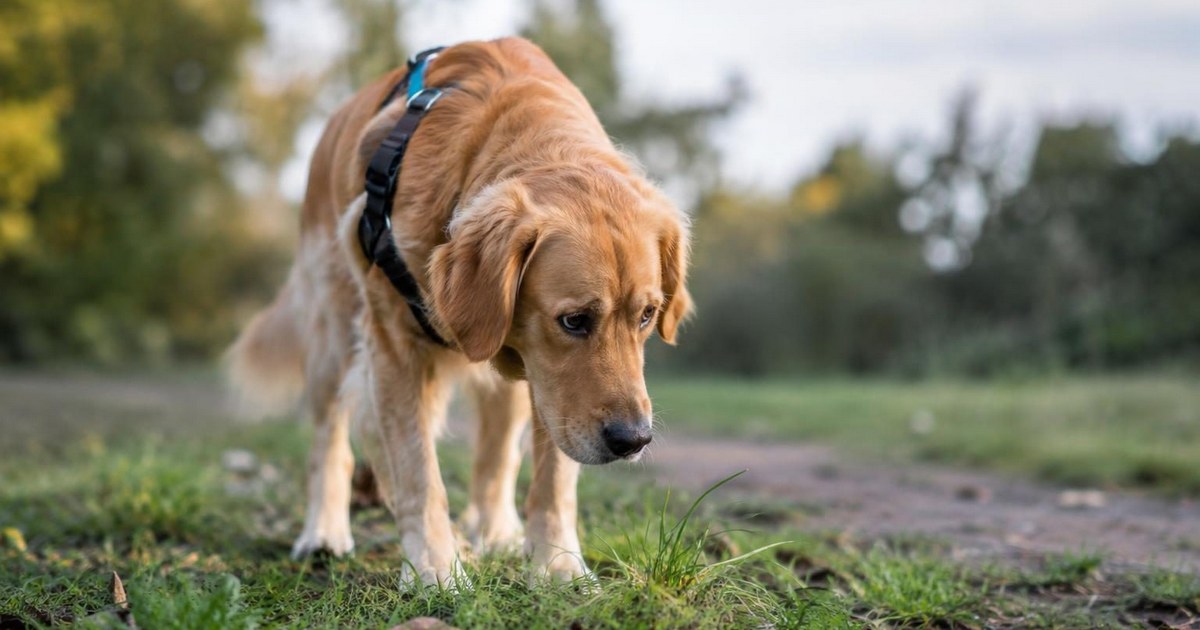
On a walk, sniffing is one of the best parts of being a dog. It is how dogs gather information about who has been around, what has changed and where they are. But an abrupt, laser-focused sniff can also be a handy social detour.
A dog may drop their nose to the grass just as an unfamiliar dog approaches head-on, when someone calls them over too eagerly, or when they are unsure how to respond to a cue. This is often described as a displacement behaviour: a normal behaviour performed in a moment of conflict, uncertainty or heightened emotion. Displacement behaviours in dogs can include sniffing, and they should not automatically be treated as disobedience.
Picture two dogs meeting on a narrow pavement. One pauses, turns slightly sideways and begins investigating a leaf with great seriousness. They may genuinely have found an interesting smell. They may also be making the encounter less intense by avoiding a direct stare and giving themselves a pause. Either way, pulling them forward to “say hello properly” removes a sensible coping option.
What it tells you: let your dog sniff when it is safe to do so. A loose lead and a wider path can turn an awkward greeting into a non-event. If your dog repeatedly uses sniffing to avoid dogs, people or particular places, consider that useful information about what feels difficult to them, rather than a failure to listen.
3. The dry shake-off after a tense moment
Most owners recognise the full-body shake that follows a bath or a swim. The more intriguing version happens when there is no water anywhere. Your dog hears the vacuum, meets an overenthusiastic stranger, tolerates a quick nail trim, then takes a few steps away and shakes from nose to tail.
That shake can be another displacement behaviour, a physical reset after a moment that required self-control or felt uncertain. It is not a diagnosis of stress on its own. Some dogs shake because their collar shifted, because they have stood up after resting or because being a dog involves a certain amount of enthusiastic wiggling. Yet when it reliably follows a slightly uncomfortable interaction, it is worth noticing.
The detail to watch is what happens next. A dog who shakes, softens their body and happily returns to investigate may simply have released a little tension. A dog who shakes and then retreats, freezes, avoids being touched or repeatedly tries to leave is giving a clearer message that they have had enough.
What it tells you: offer recovery time after experiences your dog finds challenging. After grooming, a crowded lobby or a tricky greeting, do not immediately ask for another interaction. A few quiet minutes, a chance to sniff and an easy route away can be more helpful than coaxing them back into the action.
4. The lip lick that appears when no food is around
A dog licking their lips beside a treat jar is no mystery. The same small flick of the tongue during a hug, a photo attempt or an unfamiliar handling exercise deserves more attention. Dogs can lip lick for many reasons, including anticipation and a dry mouth, but it can also appear when they are uneasy.
It is especially meaningful when it arrives in a cluster of signals. A dog whose mouth suddenly closes, whose eyes look wider, who licks their lips and turns their head away is not necessarily being stubborn about a harness or a cuddle. They may be trying to create distance without escalating. Learning to read these quieter signals matters because dogs usually prefer not to make a scene before they feel they have to.
The AKC overview of dog body language recommends considering the whole body rather than trying to decode one movement in isolation. Tail position, muscle tension, ear position, eyes and the situation all add meaning. A wagging tail, for instance, does not guarantee that a dog is relaxed.
What it tells you: pause the thing that prompted the lip lick, then give your dog an easy choice. With a harness, hold it open and let them step away for a second before trying again gently. With visitors, ask people to ignore the dog at first. With children, make sure contact is brief, supervised and never compulsory. Respecting early communication is kinder than waiting for a louder one.
5. The scratch that arrives at an oddly convenient time
Some scratches are exactly what they seem to be. Dogs get itchy. But a dog who abruptly scratches their shoulder when asked to perform a difficult cue, introduced to a new person or caught between two excited dogs may be taking a small behavioural time-out.
In an uncertain moment, scratching can function much like the sudden sniff or shake-off: it interrupts the pressure for a second. Perhaps your dog does it when you repeat “sit” in a busy park after they have stopped responding. Rather than assuming they are being wilful, ask whether the environment has become too distracting, the cue is unclear or the task has become harder than you realised.
That does not mean every scratch has a behavioural meaning. Persistent scratching, skin redness, hair loss, ear rubbing or a marked change in grooming is a health question, not a training puzzle, and merits a conversation with a vet. But the occasional, context-specific scratch can be a useful prompt to make the situation easier.
What it tells you: uncertainty often looks like a dog trying to do something else. Reduce the demand, increase distance from the distraction or return to a cue your dog knows well. Avoid framing these moments as a dog “being bad.” As the AKC explains in its discussion of supposedly bad behaviour, behaviour has a reason, and finding that reason is more productive than applying a label.
The goal is not to analyse every blink, yawn or scratch until walks become a detective assignment. It is to become fluent in your own dog’s patterns. A yawn may mean sleepiness, a sniff may be pure pleasure and a shake may be just a shake. But when small signals arrive together, at the same difficult moments, your dog may be asking for a little more space, clarity or time. Noticing that quiet request is one of the most practical ways to help them feel safer in the world.