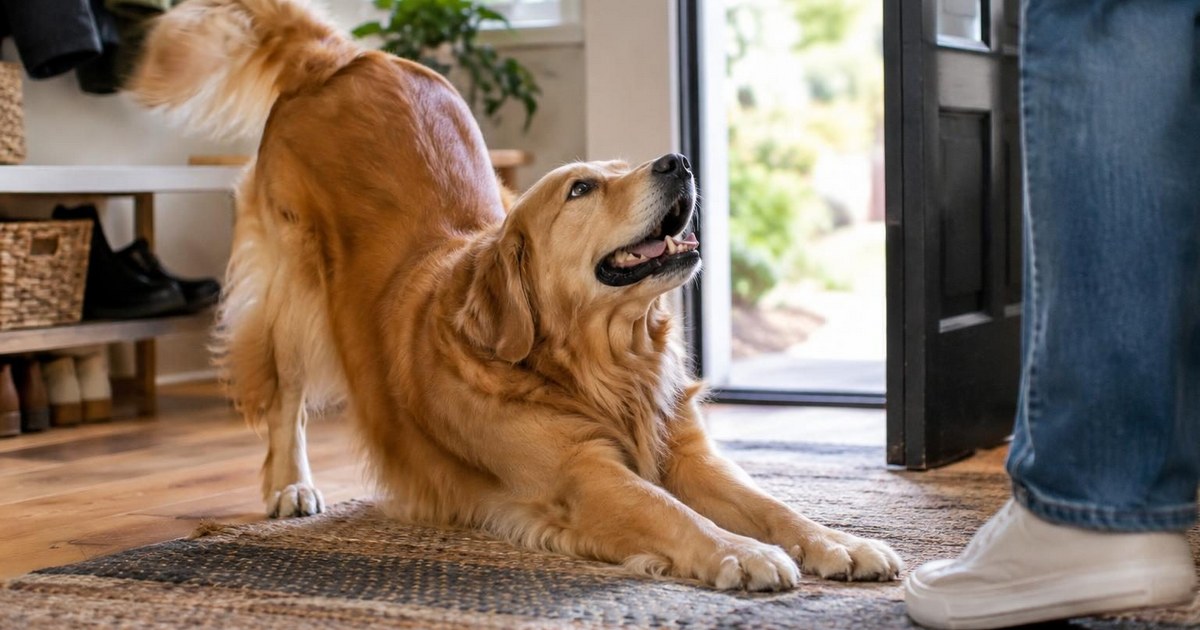
You open the door, your dog spots you, and down goes their chest while their front paws slide forward. Their back end stays high, their tail starts moving, and for a second it looks as though they are taking a tiny bow.
Many owners call this a “welcome-home stretch”, and that is often exactly how it feels. Dogs commonly stretch after resting, but a stretch that happens right as you enter can also be part of a relaxed greeting ritual. It may be your dog’s way of waking their body up, releasing a little anticipation and saying, in dog language, “You are back. I am pleased about it.”
The useful part is not trying to translate one pose in isolation. Watch what happens immediately before and after it. That context usually tells you far more than the stretch itself.
A stretch can be a social hello
When a dog stretches on seeing a familiar person, the rest of their body often looks soft and easy. Their eyes may be relaxed, their mouth may open slightly, and their tail may wag in a loose, sweeping way. They might walk straight over for a fuss, bring a toy, wiggle at the hips or roll onto their side.
This is not necessarily a formal canine “hello” with one fixed meaning. Dogs use their whole bodies to communicate, and their routines become associated with the people and moments they enjoy. If you tend to arrive home, greet your dog warmly and then head for the sofa or the lead cupboard, that stretch can become part of the happy sequence.
It is also wonderfully practical. A dog who has been asleep or resting may simply need to lengthen their muscles before they move. Think of the way people straighten up after a long car journey or stretch their arms on getting out of bed. A friendly greeting and an ordinary physical stretch can happen at the same time.
The play bow lookalike
A welcome stretch can resemble a play bow, but a play bow usually has a bit more bounce behind it. The dog may drop their front end quickly, keep their rear high, wag broadly, then spring away or turn back toward you. It is often an invitation: chase me, throw something, join in.
A greeting stretch tends to be slower and more complete. Your dog may hold it for a moment, extend one leg and then the other, yawn, and stroll over to you. Neither version needs correcting. Both are generally signs that your dog is comfortable enough to be expressive around you.
You may also notice a pattern. Some dogs reserve this behaviour for one person, perhaps the family member who handles breakfast, walks or the most enthusiastic games. That does not mean the dog loves everyone else less. Dogs are excellent observers of routine, and they can form very specific associations with particular people.
When the stretch is just part of waking up
Dogs do not need a social reason to stretch. After a nap, they may stretch their front legs, then their back legs, shake from head to tail and carry on with their day. It is a normal transition from rest to movement.
A dog may be especially likely to do this after sleeping in a curled position, getting up from a warm bed or rising after a longer period of inactivity. Older dogs can take a little longer to get going too. What matters is whether they loosen up comfortably and move normally once they are awake.
There is no need to interrupt a dog who is stretching calmly. Give them a little room, particularly if they have just woken up. Even the gentlest dog may not appreciate a hug or an excited hand reaching over them while they are still orienting themselves.
The small details worth noticing
Most stretches are ordinary. Still, a familiar daily behaviour can be useful because you know what is normal for your own dog. A change in how your dog gets up, moves or responds to touch is often more meaningful than the fact that they stretch at all.
Make a note if a dog suddenly seems stiff after rest, repeatedly stretches but appears unable to get comfortable, hesitates before jumping onto furniture they normally use, limps, cries out, avoids a particular movement or becomes unusually quiet. Those signs do not point to one single cause, but they are good reasons to arrange a veterinary conversation rather than assuming your dog is simply having an off day.
Repeated front-end stretching alongside signs of illness deserves particular attention. If your dog is vomiting, has diarrhoea, will not eat, seems painful around the belly, is restless or has a swollen-looking abdomen, contact a vet promptly. A stretched position can sometimes occur when a dog is uncomfortable, but the surrounding signs are what make it concerning. It should not be diagnosed from a pose alone.
You know your dog’s baseline better than anyone. The American Kennel Club’s dog health guidance also emphasises paying attention to changes in normal behaviour and seeking veterinary advice when something seems off. A short phone call can help you decide how quickly your dog needs to be seen.
How to respond to the happy version
When the stretch clearly comes with a relaxed, pleased-to-see-you greeting, enjoy it. You can answer in ways that keep the moment comfortable for your dog.
Pause for a second and let them finish stretching before reaching down. Greet them with a calm voice, then offer a hand low enough for them to approach if they want to. If they bring a toy, a brief game may be their preferred welcome. If they lean in for contact, a chest scratch or gentle side stroke is often less overwhelming than patting the top of the head.
For dogs who become wildly excited at arrivals, a quieter response can help. Come in, put your things down and greet your dog once all four paws are on the floor. You do not need to ignore them for a long time or make homecomings chilly. The aim is simply to keep a nice ritual from tipping into frantic jumping, barking or accidental scratches.
A little ritual tells you something bigger
The charming thing about the welcome-home stretch is that it reflects how dogs build meaning from ordinary moments. Your arrival is not just a door opening. It can signal company, movement, food, a walk, a game or the return of someone they trust.
So when your dog stretches toward you and then trots over with loose, easy body language, take it for what it most likely is: a small, unpolished expression of comfort and anticipation. It is not a secret code that needs decoding every time. But it is a lovely reminder that your dog has noticed you, remembered the routine and is ready for the next part of their day with you.