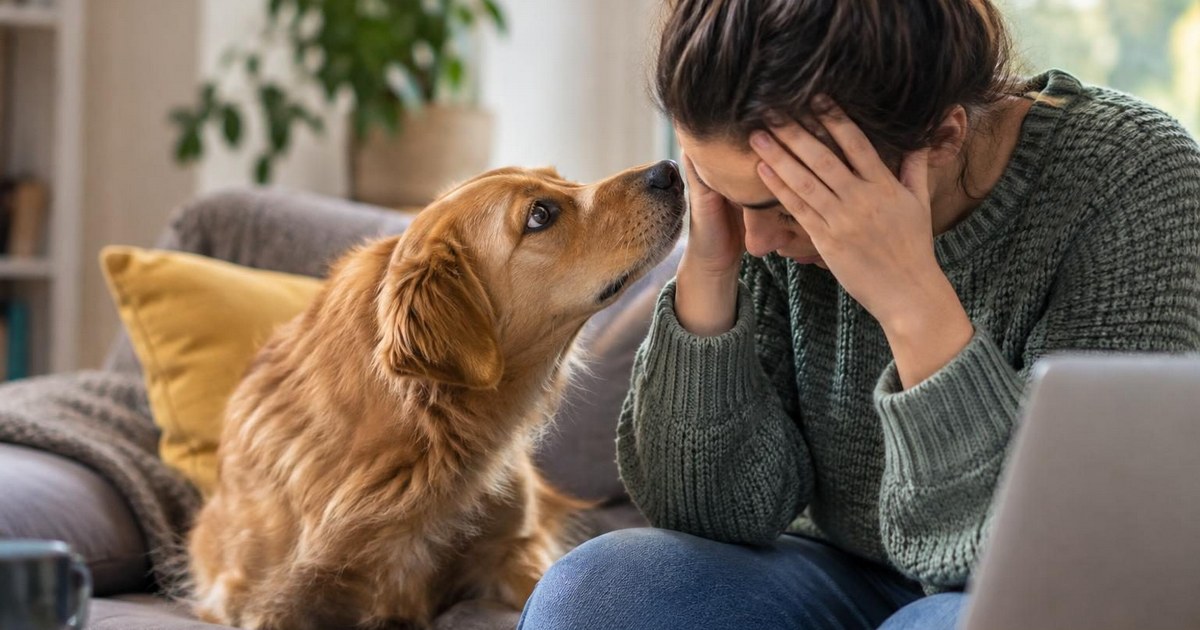
You may not say a word about the tense call, the deadline or the bad news, yet your dog can seem to know that the house feels different. Perhaps they put their nose to your hand, pace while you pace, stare at you from across the room or, unexpectedly, choose their bed instead of your lap.
None of these moments means your dog understands the cause of your stress in the human sense. But dogs are remarkably good observers of the people they live with. They take in scent, tone, movement, facial expression and changes in routine, then respond according to their own temperament and experience. Here are five subtle ways that can show up.
1. They give you a much more deliberate sniff
After a hard day, some dogs greet you with a quick hello and then return for a second, more intent sniff of your hands, clothes or breath. It can look almost investigative, especially if you have been exercising, travelling, crying or moving through a tense day at work.
That is not just a dog being nosy. Stress can alter the chemical cues we give off, and research has found that dogs can distinguish human stress odour samples from relaxed samples. In one study, exposure to the odour associated with acute human stress also affected dogs’ decision-making in a task, making them slower to approach an uncertain food location. The finding is a useful reminder that scent may be part of the information your dog gathers about your emotional state, not simply a way of identifying where you have been. Read the research on dogs and human stress odour.
The helpful takeaway is not to worry that every sniff is a crisis assessment. Dogs investigate scent because scent is how they understand the world. But when the prolonged sniff appears on days when you feel wound up, your dog may be noticing a real difference. Give them a calm greeting, let them sniff, and avoid pushing them away for trying to check in.
2. They start following the weather in your face and voice
A dog who pauses to look at you after you sigh, watches closely during an argument on speakerphone, or seems unsure when you speak sharply may be reading a collection of small signals. Dogs pay attention to human expressions and vocal cues, and studies suggest they can integrate visual and auditory information linked to emotional expression. That does not mean they interpret every frown exactly as another person would. It does mean that your face and voice are meaningful parts of their social environment.
The effect can be easy to miss because it is often quiet. Your dog may hold still when you are on edge, cock their head at a changed tone, lick their lips, blink more often or wait before responding to a familiar cue. A normally reliable recall from the kitchen might suddenly take an extra beat if your voice has a tense edge.
A review of how dogs respond to human emotional cues makes an important point for owners: dogs have opportunities to learn our emotional patterns through daily life. In other words, your dog may not be reacting only to one raised voice. They may recognise the whole package of a particular posture, pace and tone that tends to mean you are not quite yourself.
Try not to make your dog responsible for fixing the mood. Instead, make communication easier for them. Use your usual cue words in a neutral voice, keep training sessions short and upbeat, and step away from the interaction if you can feel irritation building. Consistency is reassuring when the atmosphere is not.
3. They become your small, furry shadow, or give you more space
Stress does not produce one standard canine response. One dog presses against your shin the moment you sit down. Another trails you from room to room, checks where you are, then settles a few feet away. A third quietly removes themselves to a favourite bed.
All three can be understandable reactions. Seeking proximity may reflect an established bond, curiosity about your changed behaviour or a dog’s own wish for reassurance. Creating space can be equally sensible. Dogs vary in sociability, sensitivity to noise and how comfortable they feel around abrupt movements or an unsettled household.
There is evidence that dogs’ and owners’ longer-term stress levels can be linked, including a study that measured cortisol in hair from dogs and their owners. The work does not prove that one individual always causes the other’s stress, and it cannot tell you what any single dog feels in a particular moment. It does reinforce a practical truth: shared routines and a shared home can matter to both ends of the leash. See the study of long-term stress synchronisation in dogs and owners.
Read the response in context. A dog who leans in with loose muscles, soft eyes and an easy tail is probably comfortable with closeness. A dog who heads to their bed, turns their head away, freezes or leaves when you reach for them deserves space. The kindest response is to let them choose. You can sit quietly nearby, offer a familiar chew or invite them for a gentle walk, rather than insisting on a cuddle because you need one.
4. They match your restless rhythm
Have you ever noticed your dog getting up each time you get up, hovering while you pace, or struggling to settle during an afternoon of frantic cleaning, packing or phone calls? Dogs are excellent students of household patterns. When your routine becomes more stop-start and unpredictable, their own day can become more alert and fragmented too.
This can look like sympathy, and sometimes the closeness certainly feels that way. Scientifically, it is safer to call it social and environmental sensitivity. Your dog may be responding to your faster movements, unusual noises, reduced attention, a delayed meal or walk, or the tension in your voice. Several factors can arrive together.
The useful question is not, “Is my dog absorbing every emotion I have?” It is, “What has changed in their day?” A few minutes of slow sniffing outdoors can be more settling than an intense game of fetch if you are both already overstimulated. Put their meal down at the usual time if possible. Give them a predictable place to rest away from the kitchen, front door or the room where you are taking difficult calls. A regular routine is not a cure for stress, but it gives your dog some dependable landmarks in a day that has become noisier or less predictable.
Watch for stress signals that are more than simple attentiveness, such as persistent pacing, panting when they are not hot, repeated vocalising, inability to settle, hiding or destructive behaviour. If these are new, frequent or escalating, speak with your vet. Physical discomfort and anxiety can look alike, and a professional can help you work out what needs attention.
5. They become strangely quiet around emotional moments
The stereotype says dogs always rush in to comfort us. Many do. But a dog who goes still, lowers their body, watches from the doorway or retreats during crying, raised voices or frantic activity may be giving you equally valuable information: the situation feels confusing or uncomfortable to them.
Dogs can show signs of emotional contagion, meaning they may respond to the emotional state of another individual without needing to understand the reason behind it. Research exploring dog-owner interactions has found physiological and behavioural evidence consistent with this kind of emotional connection, while also highlighting that context and individual differences matter. The evidence on emotional contagion between dogs and people is a good reason to resist one-size-fits-all stories about “empathic” dogs.
If your dog goes quiet, do not interpret it as a lack of affection. It may be their way of coping. Lower the volume where you can, avoid reaching over them or repeatedly calling them back, and make sure they have a comfortable retreat that nobody disturbs. For some dogs, the most reassuring thing you can offer is permission not to participate.
This is especially worth remembering in homes where stress means more visitors, family conflict, disrupted sleep or children moving unpredictably. A dog who normally loves company may need a calm room, a baby gate or a planned break. Their behaviour is communication, not a bad attitude.
Your dog is not a mind reader, a therapist or a barometer that can diagnose your wellbeing. Still, they live close enough to notice the details that other people often miss: the scent on your skin, the break in your routine, the way your voice lands differently in the room. Seeing their reaction as information, rather than proof that they must comfort you, can make difficult days gentler for both of you. A quiet walk, a predictable meal and the freedom to choose closeness or space are small acts of care that travel well in either direction.